
When you don’t feel well, it’s natural to want quick answers.
But the internet’s advice can be overwhelming (and sometimes just plain scary).
That’s why AI symptom checkers have become so popular. They give you fast, simple explanations for what might be going on, without the doom-scrolling.
But how do AI symptom checkers work?
How accurate are they? And which ones can you trust?
Let’s walk through everything.
What Is an AI Symptom Checker?

(Image Source: Canva)
An AI symptom checker is an online tool that guides you through your symptoms and gives possible explanations.
You type what you’re feeling, and the AI:
- Understands your description
- Asks relevant follow-up questions
- Suggests potential causes
- Tells you how urgent it might be
- Gives basic next-step guidance
- Connect you straight to a doctor (with Air Doctor’s AI symptom checker)
It’s not a diagnosis.
But it is a useful first step when you need clarity fast — especially late at night, while traveling, or when you can’t see a doctor right away.
How Do AI Symptom Checkers Work?
Here’s the simple version:
You enter symptoms → AI analyzes them → You get tailored guidance.
Let’s look at that process in more detail.
Data Input & User Interaction
You start by describing your symptoms.
NLP (Natural Language Processing) helps the tool understand everyday language — even vague, human phrasing like “my stomach feels weird.”
It may ask follow-up questions:
- “How long?”
- “How severe?”
- “Any fever?”
This helps the AI refine its understanding.
Medical Knowledge Base
Behind the scenes, AI symptom checkers rely on a curated medical database.
This usually includes:
- Clinical guidelines
- Symptom–condition patterns
- Public health data
- Doctor-reviewed inputs
It acts like a large, structured map that links symptoms to possible causes.
Machine Learning & Probabilistic Reasoning
Once your symptoms are understood, the AI estimates likelihoods.
It looks for patterns such as:
- Which symptoms commonly occur together
- How symptoms present in certain age groups
- Which conditions are most likely based on your input
It’s not guessing; it’s assessing probability.
Some models blend AI reasoning with doctor-designed logic, which can increase reliability.
Decision Trees vs. Large Language Models (LLMs)
Older tools use what’s known as decision trees — simple yes/no flows.
Newer ones use AI language models (like ChatGPT, Claude, and Perplexity), which:
- Allow natural conversations
- Understand context
- Respond flexibly
- Ask dynamic questions
LLMs feel more intuitive, but require strict safety rules so they don’t “hallucinate” medical answers.
Output Generation
The final step is generating your results.
You’ll usually see:
- A few possible explanations
- Why these conditions fit
- Guidance like “monitor at home” or “see a doctor within 24 hours”
- Red-flag warnings if needed
Good tools explain everything in simple, reassuring language.
Pros of AI Symptom Checkers
- Available 24/7
- Quick answers
- Great for first-step triage
- Usually free
- Less overwhelming than Googling
- Helps avoid unnecessary appointments
- Can reduce anxiety by offering clarity
Cons of AI Symptom Checkers
- Not a replacement for a doctor
- Accuracy varies across tools
- Some may undertriage or overtriage
- Users may misread the guidance
- Privacy practices differ
Think of them as helpful guides, not final answers.
Technical and Clinical Constraints
AI symptom checkers are smart; but they have real limits.
- They depend on the data they were trained on
- They struggle with vague symptoms
- They can’t perform physical exams
- They may miss rare diseases
- Some models reflect data bias
- Regulation is still catching up
- LLMs can still produce incorrect (but confident) answers
These limits are why medical oversight remains essential.
How Accurate Are AI Symptom Checkers Really?

(Image Source: Canva)
Accuracy is one of the biggest questions people have — and the truth is: it varies. A lot.
Accuracy Varies Across Tools
Accuracy among symptom checkers differs widely.
A study published in the National Library of Medicine (NLM) found that some tools list the correct condition in their top results less than half the time, while others perform significantly better.
Consumer-oriented tools typically prioritize safety over precision.
Clinical-grade tools (used by doctors) are much more accurate but aren’t usually available to the public.
Rule-Based vs. LLM vs. Hybrid
- Rule-based tools = predictable but limited
- LLM-based tools = flexible but must be tightly controlled
- Hybrid models (AI + medical logic) often perform better because they combine flexibility with safety rails
Why Accuracy Is Often Misunderstood
Many users assume:
“If it showed me Condition X, I must have Condition X.”
But symptom checkers are designed to offer possibilities, not conclusions.
Accuracy depends on:
- The clarity of your input
- The model’s training data
- Whether medical experts are involved in validation
Why Human Medical Review Still Matters
Doctors don’t just check symptoms: they check context, nuance, body language, tone, physical signs, medical history, and more.
AI can’t replicate that (yet), which is why trusted pathways to real doctors are essential.
Air Doctor’s symptom checker intentionally closes this gap by connecting users to vetted physicians when needed.
Risks & Controversies in AI Symptom Checkers
Like any new technology, AI symptom checkers also bring risks.
Misinformation or Incorrect Suggestions
JMIR Research found that symptom checker accuracy varies dramatically.
Lack of Regulation
There are currently few global standards for evaluating the safety of AI symptom checkers.
Data Privacy Concerns
Some tools collect large amounts of personal data — not all disclose how it is stored or used.
Bias in Training Data
If a model is trained mostly on certain populations, it might misinterpret symptoms from others.
AI Overconfidence
LLMs, in particular, can produce wrong answers confidently unless guardrails are in place.
What Users Should Look For
A safer symptom checker should:
- Be medically backed
- Explain its limits clearly
- Offer transparent methods
- Protect personal data
- Provide a pathway to a real doctor
- Avoid making definitive medical claims
(Air Doctor’s Symptom Checker ticks all these boxes.)
About The Air Doctor AI Symptom Checker
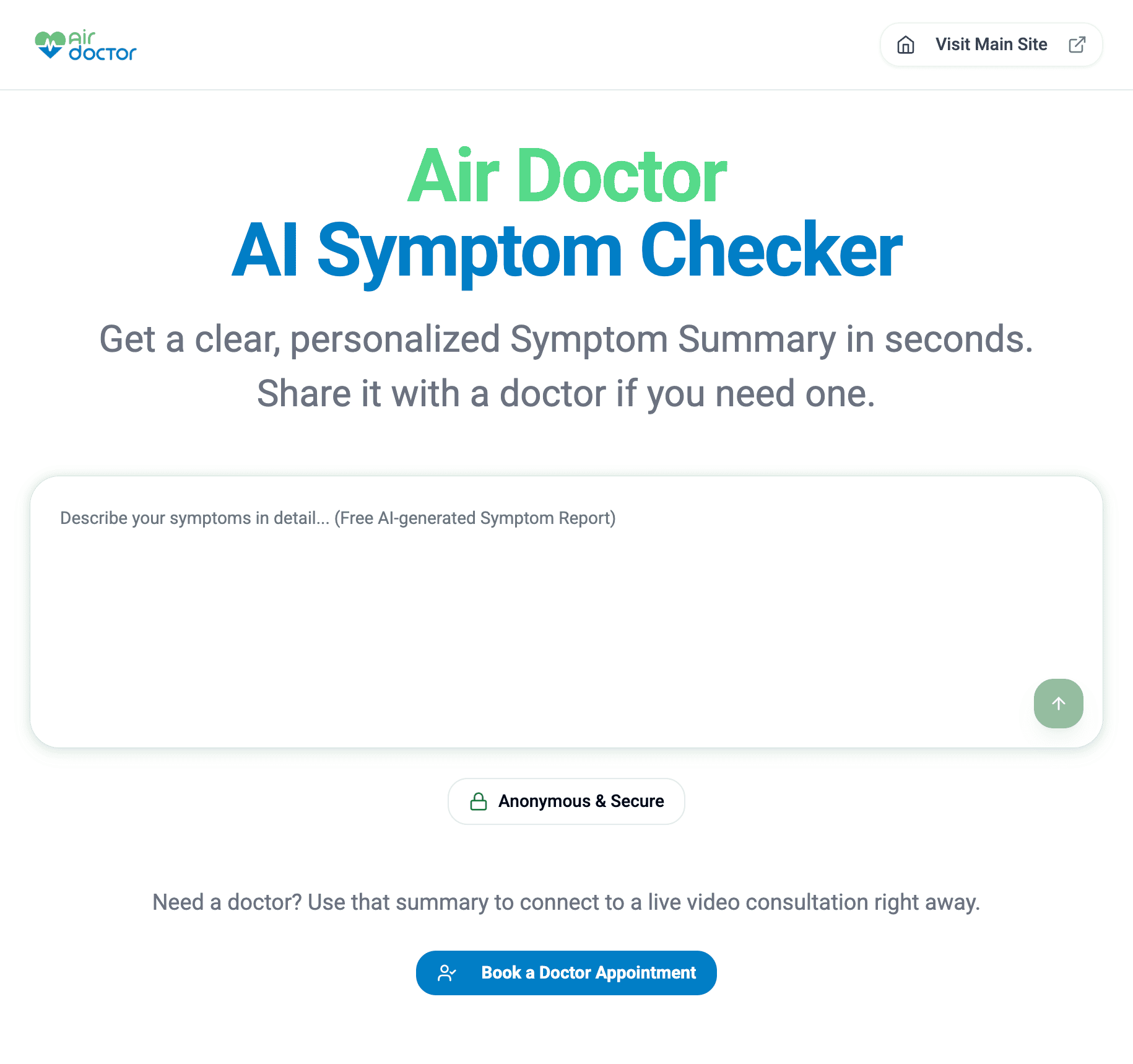
Air Doctor built its AI symptom checker with one purpose:
Give people quick, private clarity — backed by real doctors, not just algorithms.
How It Works

Air Doctor uses a clear, structured 8-step flow that helps the AI understand your symptoms more accurately than a simple chat box.
- Chief Complaint – What’s bothering you
- Personal Info – Age/sex for context
- Symptom Details – How it feels, how long, what affects it
- Medical History – Conditions, meds, past issues
- Allergies – Important for safe guidance
- Lifestyle – Habits, travel, daily routines
- Daily Impact – How symptoms affect your functioning
- Expectations – What you want to understand or achieve
Once completed, the AI gives a clear, friendly summary of what your symptoms might mean and simple next steps.
If care is recommended, you can instantly connect with a trusted medical specialist that speaks your language.
Who It’s For
Air Doctor is ideal for:
- Travelers
- Expats
- Digital nomads
- Students
- Busy families
- Anyone without easy access to local healthcare
What Makes It Unique
Air Doctor isn’t “just another AI tool.”
It’s backed by:
- A trusted global network of vetted doctors
- Multiple languages
- Local and global medical insights (“glocal”)
- Video and in-person appointments
- Real medical oversight
Most symptom checkers stop after giving suggestions.
Air Doctor keeps going by ensuring you can actually see a doctor if needed.

Why It’s Great
People often feel anxious and alone when dealing with symptoms; especially abroad.
Air Doctor gives:
- Quick reassurance
- Clear, friendly explanations
- Practical next steps
- Access to real doctors who can help
- A feeling of control during uncertainty
It’s private.
It’s fast.
And it’s judgment-free.
Privacy & Trust Features
Your privacy matters.
Air Doctor:
- Keeps your data confidential
- Never sells symptom data
- Uses ultra-secure systems
- Works only with vetted doctors
- Provides safe, responsible guidance
It’s AI with ethics — and with human doctors built in from the start.
Best Practices for Using AI Symptom Checkers
- Describe your symptoms clearly
- Use symptom checkers for guidance, not diagnosis
- Know emergency red flags
- Follow up with a doctor for anything serious
- Combine AI insight with professional medical advice
In Short
AI symptom checkers are helpful, fast, and increasingly smart.
They offer clarity when you need it most — especially if you’re traveling or can’t reach a doctor right away.
They’re not perfect. They’re not doctors.
But they are incredibly useful as a first step.
With Air Doctor, that first step leads to something even better: real medical care from trusted doctors around the world.
About Air Doctor
With the Air Doctor app in your pocket, you can access medical care and receive expert medical guidance anywhere you travel.
Air Doctor offers a wide range of benefits, including:
- A global network of multi-lingual doctors and specialists
- An AI symptom checker that connects you straight to a trusted, local doctor
- Choice of clinic, at-home (hotel), and video consultations
- Healthcare access in 90 countries
- 24/7 multi-lingual support
- Transparent pricing and reviews
- Most common medical specialties, including cardiologists
FAQs
Are AI symptom checkers free to use?
Yes. Some are free — including Air Doctor’s.
Can AI symptom checkers replace a doctor?
No. They support your decision-making but don’t diagnose or treat medical conditions.
Can I trust online symptom checkers?
You can trust reputable, medically-backed ones.
Still, treat results as guidance, not fact.
Do AI symptom checkers give medical advice?
No — they provide general information.
Only doctors provide medical advice.
Can AI symptom checkers detect rare diseases?
Sometimes, but not reliably.
Rare conditions often require professional evaluation.