
AI is becoming a big part of everyday healthcare — from online symptom checkers to appointment triage to tools that help doctors analyse information faster. It’s exciting, but it also makes a lot of people wonder:
Could AI ever replace real doctors?
In short: No.
But AI can make healthcare faster, more accessible, and less stressful — especially when you need guidance early on.
This article takes a simple, honest look at what AI does well, where it falls short, and how doctors + AI are already working together in modern healthcare.
What AI Can Do Well in Early Symptom Assessment

AI is incredibly useful for the first step of understanding your symptoms — especially if you’re feeling anxious, travelling, or stuck waiting days for an appointment.
Here’s what AI genuinely does well:
It quickly recognises symptom patterns
You can type something casually like “tight chest and tired,” and AI can interpret the meaning using clinical logic.
If you’re curious how this works behind the scenes, we’ve got a great guide on how AI symptom checkers work.
It asks follow-up questions you might not think of
Most people forget important details when describing symptoms. AI tools help by asking structured questions, like how long it’s been happening or what makes the symptom worse.
It helps you understand your next steps
AI doesn’t guess — it provides a safer, calmer suggestion such as:
- monitor at home
- book a routine appointment
- consider urgent care
It’s instantly available
At 2am, on holiday, or in a country where you don’t know the local healthcare system — AI is there.
It can reduce unnecessary visits
For mild issues that resolve on their own, AI helps you avoid panic spirals or unnecessary trips to a clinic.
Where AI Still Falls Short Compared to Human Clinicians
Even the smartest AI has limits — and being transparent about them builds trust.
It can’t perform a physical exam
AI can’t listen to your lungs, look at a rash, check your pulse, or assess dehydration.
It doesn’t pick up subtle cues
Doctors instantly notice things like breathing effort, body language, tone of voice, or unusual colouring — AI can’t.
It struggles with vague symptoms
If you say, “I just feel wrong,” a doctor can probe deeper. AI can’t interpret intuition.
It can’t run tests or confirm a diagnosis
Bloodwork, X-rays, urine tests — essential steps that require real medical professionals.
It lacks emotional intelligence
AI can explain things, but it can’t offer empathy, compassion, or reassurance when you’re scared.
Rare or unusual presentations are difficult for AI
AI works best with common patterns, not rare medical situations.
If you want to understand why humans misread symptoms on their own, we’ve got a great guide on common medical symptoms people misinterpret.
The Role AI Plays in Supporting, Not Replacing, Care
Instead of competing with doctors, AI actually makes their jobs easier — and your experience better.
It helps people make decisions earlier
You don’t have to sit in confusion for hours (or days).
AI can point you in the right direction fast.
If you’re someone who tends to Google symptoms, we’ve got a great guide on AI symptom checkers vs Googling that breaks down the differences clearly:
It helps doctors by organising information
Arriving at a consultation with a clear symptom summary saves time and makes conversations smoother.
It supports overwhelmed healthcare systems
By filtering mild cases, AI reduces unnecessary appointments — freeing doctors for more complex ones.
It makes healthcare more accessible
Whether you’re abroad, living remotely, or unable to get a quick appointment, AI gives you clarity you might not otherwise have.
How Doctors and AI Work Together in Modern Healthcare
The future of healthcare isn’t AI replacing doctors — it’s AI supporting them.
AI handles data; doctors handle decisions
AI can analyse symptoms quickly, but doctors use judgment, experience, and context to make the final call.
Doctors use AI for triage and admin
Symptom checkers streamline the intake process and reduce waiting room overload.
AI offers a second perspective
While doctors use their expertise, AI can flag relevant patterns or possible conditions to consider.
Together, they improve patient care
Faster, clearer, more structured care from start to finish.
Why Human Expertise Remains Essential
There’s a reason AI won’t replace doctors:
Medicine requires nuance
Two people can have the same symptoms for totally different reasons — something only humans can judge.
Doctors see what AI can’t
Subtle behaviours, emotional distress, physical signs — these matter.
Experience and intuition matter
Years of real patient care give doctors instincts no algorithm can mimic.
Human reassurance is irreplaceable
Sometimes you don’t just need information — you need support.
Doctors give the final say
AI is a tool.
Doctors are the decision-makers.
If you want a deeper look at how safe AI really is, we’ve got a great guide on whether AI symptom checkers can be trusted.
A Quick Look at Air Doctor’s AI Symptom Checker
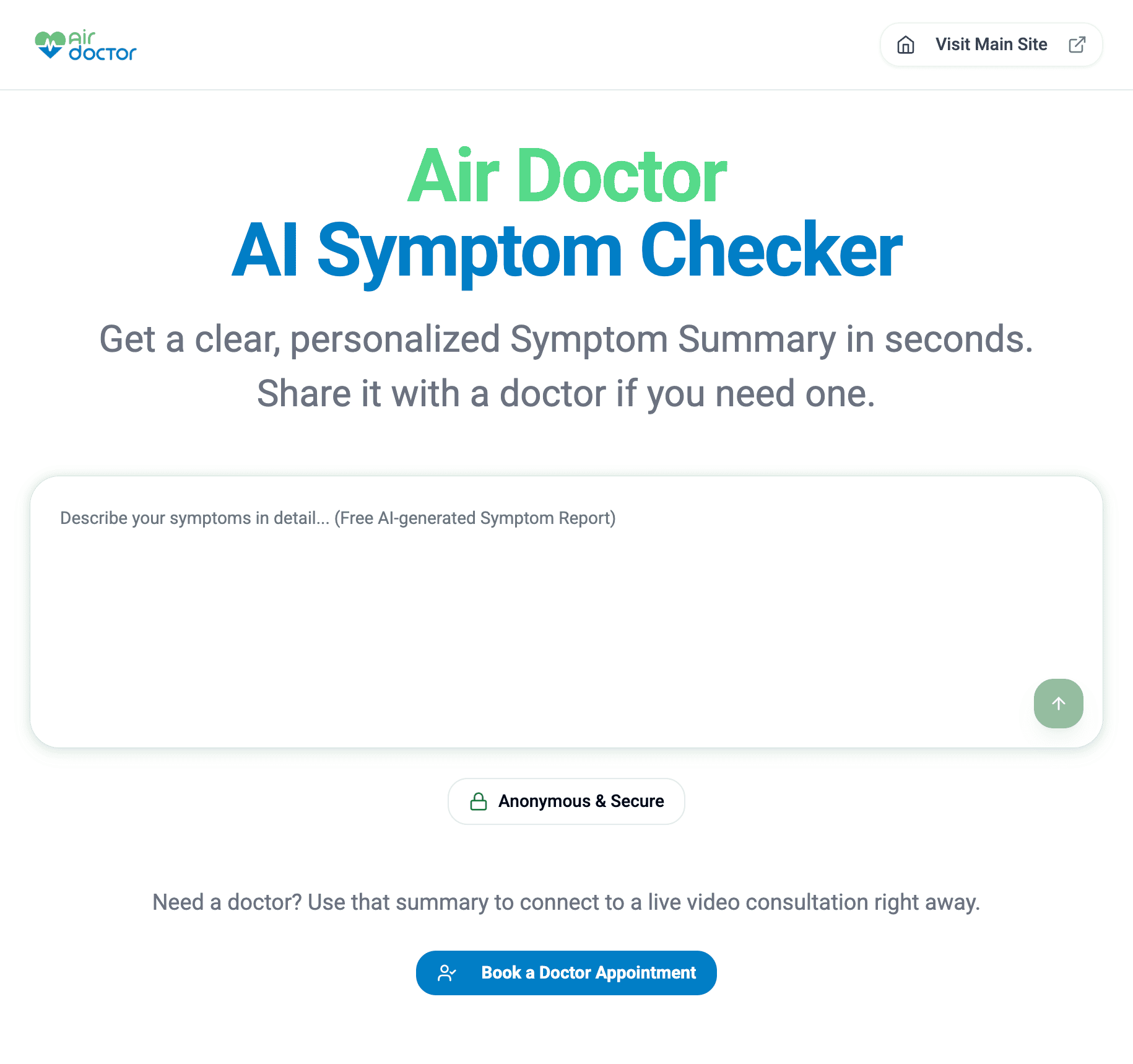
If you’re curious about using AI safely, Air Doctor’s tool was built to give you clearer guidance — without guessing or panic.
It uses a structured 8-step flow

Instead of vague chat prompts, it walks you through:
- your main symptom
- how long it’s been happening
- medical history
- lifestyle factors
- how the symptom affects your day
This helps the AI give more accurate, relevant suggestions.
It explains your symptoms in simple language
You get a clear summary and practical next steps — not complicated medical jargon.
It never pretends to diagnose
It guides you, not labels you.
If you need a doctor, you can book one immediately
The tool connects you to vetted doctors (online or in person) who speak your language — something most symptom checkers don’t offer.

Conclusion
AI is transforming healthcare, but it’s not replacing doctors.
What it can do is help you understand your symptoms earlier, reduce worry, and prepare you for a better conversation with a real clinician.
The future of healthcare is simple:
AI gives you clarity.
Doctors give you care.
And together, they make the entire experience better.
About Air Doctor
With the Air Doctor app in your pocket, you can access medical care and receive expert medical guidance anywhere you travel.
Air Doctor offers a wide range of benefits, including:
- A global network of multi-lingual doctors and specialists
- Choice of clinic, at-home (hotel), and video consultations
- Healthcare access in 90 countries
- An AI symptom checker that connects you directly to a medical specialist
- 24/7 multi-lingual support
- Transparent pricing and reviews
- Most common medical specialties, including cardiologists
FAQs
Does AI outperform doctors?
No. AI can analyse data quickly, but doctors remain far more accurate in real-world diagnosis because they can perform exams, interpret nuance, and use experience.
What diseases can AI diagnose?
AI doesn’t diagnose. It suggests possibilities to help you understand what your symptoms might indicate. Only a doctor can confirm anything through tests or examination.
Can a gynecologist be replaced by AI?
No. Gynecology requires physical exams, specialised testing, and human judgement. AI can support early guidance, but it cannot replace specialist care.